

Did the Sword and Fairy 4 Remake Plagiarize Clair Obscur: Expedition 33?——Foreign Game Copyright & Infringement in China
In December 2025, UP Software released the official trailer for the remake of The Legend of Sword and Fairy 4 (hereinafter, the "Sword and Fairy 4 Remake"), providing the first comprehensive look at key features such as the combat system, the combat UI, and cinematic staging. Following the trailer's release, some players and media outlets compared it with Clair Obscur: Expedition 33 (hereinafter, "Expedition 33"), developed by France-based Sandfall Interactive and published by Kepler Interactive, and argued that the two share similarities in areas including the in-scene, embedded display of combat commands, interaction prompts for guarding and counterattacking, the UI information architecture, and the pacing of audiovisual presentation. This has sparked debate over whether these similarities amount to "inspiration" or "plagiarism." Applying the evaluative framework under Chinese law, this article first confirms the basis on which Expedition 33, as a foreign work, is protected within the territory of China; it then delineates the boundaries of protectable elements of game content under Chinese copyright law; and, following the judicial review approach of "Access + Substantial Similarity," conducts a preliminary analysis of the trailer's most contested elements—such as art assets, interactive presentation, and UI design.
Whether Expedition 33, as a foreign game, is protected under China's Copyright Law
When assessing the potential copyright risks that the Sword and Fairy 4 Remake may implicate, it is first necessary to confirm whether Expedition 33, as a foreign work, is entitled to copyright protection within the territory of China and therefore provides a basis for rights enforcement.
Article 2(2) of the Copyright Law of the People's Republic of China (as currently in force) provides that works of foreign nationals and stateless persons are protected under this Law where, pursuant to agreements concluded between China and the author's country of nationality or habitual residence, or pursuant to international treaties to which both China and that country are parties, such works enjoy copyright. Expedition 33 is a game developed by France-based Sandfall Interactive and published by Kepler Interactive. France, the United Kingdom, and China are all contracting parties to the Berne Convention for the Protection of Literary and Artistic Works (hereinafter, the "Berne Convention"). Under Article 5 of the Berne Convention:
(1) Authors shall enjoy, in respect of works for which they are protected under this Convention, in countries of the Union other than the country of origin, the rights which their respective laws do now or may hereafter grant to their nationals, as well as the rights specially granted by this Convention.
(2) The enjoyment and the exercise of these rights shall not be subject to any formality; such enjoyment and such exercise shall be independent of the existence of protection in the country of origin of the work. Consequently, apart from the provisions of this Convention, the extent of protection, as well as the means of redress afforded to the author to protect his rights, shall be governed exclusively by the laws of the country where protection is claimed.
Accordingly, reading Article 2(2) of the Copyright Law in conjunction with the Berne Convention, Expedition 33, as a work originating from a Berne Convention member state, is in principle protected under China's Copyright Law. The right holder(s) may therefore seek civil remedies in China against infringing acts occurring within China, including unauthorized reproduction, adaptation, and communication to the public via information networks.
The Scope of Protection for Game Content Under China's Copyright Law: Protecting Specific Expression, Not Gameplay Mechanics and Rules
Under China's Copyright Law, the principal boundary of protection for game content remains the Idea/Expression dichotomy: only original intellectual achievements in the literary, artistic, and scientific domains that are expressed (or capable of being expressed) in a tangible form constitute "works" and are protected. By contrast, abstract ideas, concepts, methods, and rules do not fall directly within the scope of copyright protection. Accordingly, in the gaming context, it is necessary to distinguish between gameplay concepts and rule systems and concrete presentations that are perceptible and fixed (or capable of being fixed), so as to define both the protectable subject matter and the proper scope of comparison.
As a matter of statutory categorization, video games are not listed as an independent category of works under Article 3 of the Copyright Law of the People's Republic of China. In practice, however, a game is composed of multiple separable expressive elements, each of which may fall within different categories of works and thereby receive protection. For instance, worldbuilding, narrative text, NPC dialogue, and skill descriptions may constitute written works; theme songs, BGM, and sound effects may constitute musical works; character concept art, 3D model textures, environment key art, maps, item appearances, and aesthetically expressive UI icons and interface art may constitute works of fine art; cutscenes, opening and ending sequences, promotional videos, and eligible continuous moving images may constitute audiovisual works; and client-side/server-side programs, engines, and scripts are protected as computer software works.
Conversely, many aspects that are easily (and often mistakenly) characterized as "plagiarism" may lie outside the domain of direct copyright protection. These include gameplay rules, system frameworks, numerical/statistical mechanisms, and their interactive relationships, which are generally characterized as rules, methods, or mechanism design rather than copyrightable expression. As a result, in copyright disputes involving games, the analytical focus typically is not whether the gameplay "feels similar," but whether the defendant has copied or adapted the claimant's original, concrete expression—for example, specific UI icons and interface art, or visual content and staging segments that can be fixed and compared.
In this case, the genre-typical JRPG gameplay reflected in Expedition 33 and its "turn-based + real-time input prompts (QTE)" interaction mechanism, even if innovative to some degree, would generally be categorized as gameplay rules and mechanism design (at the level of ideas), and thus would be difficult to protect directly as expression under China's Copyright Law. By contrast, its specific art assets, stylized UI elements, cutscenes and eligible continuous moving images, and the program code implementing such interactions are more likely, provided they satisfy requirements such as originality, to be protected under China's Copyright Law as works of fine art, audiovisual works, and/or computer software works, respectively.
Whether the Sword and Fairy 4 Remake May Constitute Copyright Infringement in Expedition 33
In Chinese judicial practice, copyright infringement cases premised on alleged "plagiarism" are typically assessed under the "Access + Substantial Similarity" standard. Under this two-step approach, the plaintiff must first show that the defendant had an opportunity to access the plaintiff's work; the court then compares the two works to determine whether the accused work is substantially similar to the original work in its protectable, original expression. Only where both "access" and "substantial similarity" are established will a court typically infer copying and find copyright infringement.
3.1 Access
With respect to the "Access" element, Chinese judicial practice generally does not require the plaintiff to prove the defendant's actual access, but instead focuses on whether access or the likelihood of access can be shown. Courts typically make a holistic assessment based on factors such as whether the prior work was publicly released and the scope of its dissemination, as well as whether there were channels of contact between the parties (e.g., cooperation negotiations) through which access could have occurred. Expedition 33 was publicly released on April 24, 2025, and offered Chinese-language support on mainstream platforms, providing conditions for dissemination among Chinese players and for exposure to industry practitioners in China. Its receipt of "Game of the Year" at The Game Awards (TGA) in December 2025 further increased its industry visibility. Meanwhile, as of December 2025, the Sword and Fairy 4 Remake remained at the stage of public trailer release with no announced release date. It is therefore reasonable to infer that its development period overlapped with Expedition 33's release and subsequent period of heightened visibility, supporting the conclusion that the "likelihood of access" element may be satisfied.
3.2 Substantial Similarity
Considering Section 2 (Scope of Protection for Game Content Under China's Copyright Law), China's Copyright Law protects only original, concrete expression in a game, such as text, music, and art, and does not protect game mechanisms and rules. Accordingly, the substantial similarity inquiry should focus on expression: it should first exclude unprotectable ideas, functional elements, and industry-common conventions, and then compare the remaining protectable expression using both overall impression and element-by-element analysis. Because the Sword and Fairy 4 Remake has not yet been officially released, the discussion below is necessarily preliminary and based only on the demo footage shown in the official trailer; any final conclusion should be assessed in light of the complete released version and the evidence relating to access.
3.2.1 Artistic Style and Visual Elements
In terms of visual presentation, both the Sword and Fairy 4 Remake and Expedition 33 appear to favor a realist-fantasy, next-generation 3D style, emphasizing lighting effects and atmospheric rendering. It should be noted that abstract subject-matter themes, overall style, and ambience (e.g., dark-toned fantasy, a grand and mysterious mood, cinematic lighting) are generally closer to aesthetic preferences and fall within a space of industry-common expression. In principle, they are not directly protected by copyright, and similarity in style or atmosphere alone is insufficient to establish copying or substantial similarity.
At the same time, specific expressions in game art may still be protectable, for example, the morphological details of particular scene or character models, distinctive symbolic ornaments, compositional choices, and the particular combination of such elements. Accordingly, to argue substantial similarity at the art level, one would typically need, after filtering out common elements, to compare key frames and demonstrate a high degree of overlap in such specific expressions. Based on currently disclosed demo materials, however, the two titles appear to differ materially in thematic background and character systems. At this stage, it is more appropriate to characterize the dispute as one of "similar genre style and atmosphere," and whether it rises to substantial similarity in the copyright sense remains to be assessed on the basis of more concrete visual evidence.
3.2.2 Combat Mechanics and Interactive Presentation
As noted above, Expedition 33 introduces real-time interactions such as guarding and dodging on top of a traditional turn-based structure, triggering a guard at the moment of an enemy attack to mitigate damage and potentially counterattack. The Sword and Fairy 4 Remake trailer also shows a similar guard timing and counterattack presentation. From a copyright perspective, gameplay rules, interaction mechanics, and system logic are generally considered to fall on the "idea" side of the Idea/Expression dichotomy and are not directly protected. Therefore, similarity in a "turn-based + real-time input prompts (QTE)" mechanism is generally insufficient to establish copyright infringement.
What warrants further assessment is whether the specific mode of presenting that mechanic involves extensive copying at the expression level, for example, the action animation upon a successful guard, visual effects design, prompt UI, camera choreography, and editing pace. If, in key scenarios (such as the instant a guard succeeds), both titles exhibit highly consistent slow-motion close-ups, camera push-ins, freeze-frames and white flashes, identical prompt wording and placement, and similar camera trajectories and cut points, such that key frames or continuous segments overlap to a high degree, then there may be a risk of copying the audiovisual expression embodied in gameplay footage, or related artistic expression. Conversely, if the similarity is limited to generic cinematic techniques such as slow motion and close-ups, or presentations necessary to deliver functional feedback, it would be difficult to find infringement on that basis.
Overall, while combat mechanics themselves are not protected by copyright, the accompanying animations, effects, UI prompts, and camera/editing organization, after functional and industry-common expressions are filtered out, may fall within the expression layer that should be further compared and substantiated under a "Substantial Similarity" analysis.
3.2.3 User Interface (UI) Design
Based on the currently available trailer footage of the Sword and Fairy 4 Remake, both titles appear to adopt an approach in which combat commands are embedded into the scene and displayed near the character's position; party portraits and turn-order information are placed on the left; enemy HP bars at the top; and character status information at the bottom right. The overall information architecture may therefore appear similar at first impression. It should be noted that separating menus and command prompts from the traditional bottom-aligned menu format and presenting them in a more immersive manner closer to the character or scene is not a UI paradigm unique to Expedition 33. Similar approaches can also be found in works such as the Persona series, where combat commands and button prompts are organized and presented in a more scene-integrated manner. Accordingly, the relevant similarities are more likely to fall at the level of UI presentation approach and information architecture, and any copyright comparison should be conducted only after functional and industry-common expressions are excluded.
On the other hand, based on what has been disclosed in the trailer, the Sword and Fairy 4 Remake appears to use a more pronounced radial command structure (with distinct arc trajectories and numbered sequences, black-background circular icons, etc.), whereas Expedition 33 leans more toward a slanted, list-based command presentation. The two therefore exhibit visible differences in specific graphical expression (including component shapes, line structures, decorative style, typography, and color scheme), making it difficult to directly conclude that their UI art expressions are highly similar. To further evaluate whether there is substantial similarity in the copyright sense, the analysis would need to exclude functional and industry-common elements and then conduct an element-by-element comparison of the core UI components.
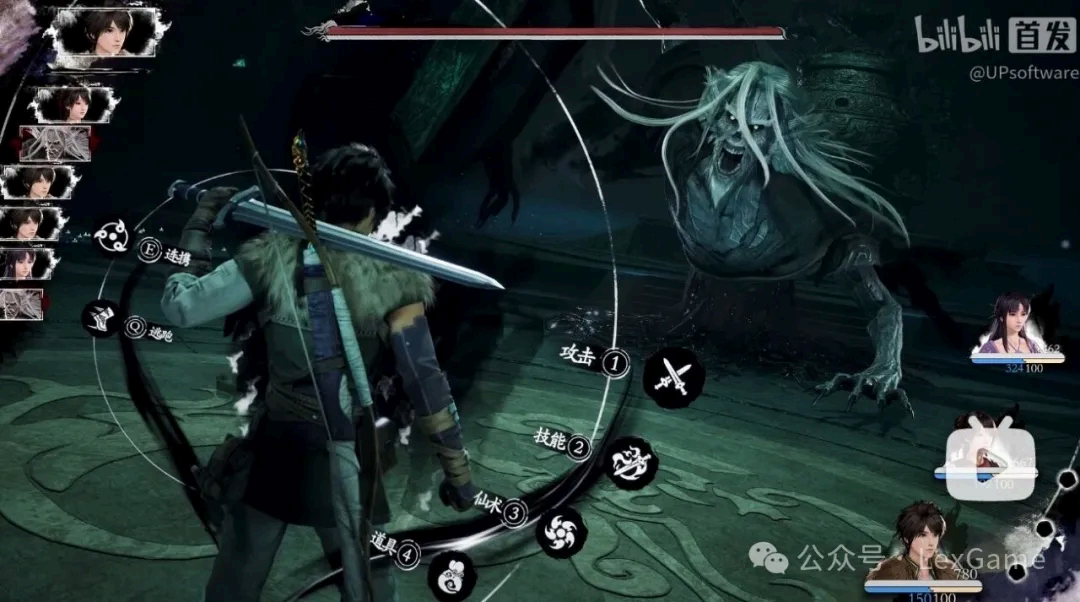
*Screenshots from UP Software's video published on its account on the Bilibili platform, "The Legend of Sword and Fairy 4 Remake Official Trailer - Tiandao Wuchang."*
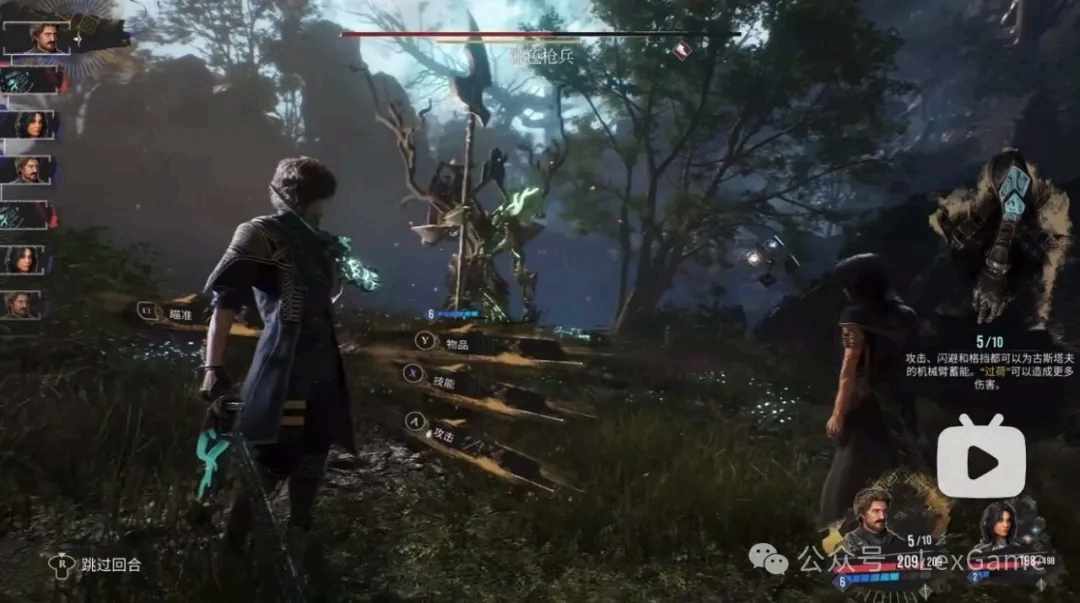
*Screenshots from IGN China's video published on its account on the Bilibili platform, "Clair Obscur: Expedition 33 - 60-Minute Gameplay Demo."*
Summary
In summary, based on the demo footage shown in the currently available official trailer for the Sword and Fairy 4 Remake, the two titles exhibit certain similarities in areas such as the information architecture and presentation approach of the combat UI. However, at the level of specific graphical expression that may be protected by copyright, further verification would require evidence such as the complete content of the released version and side-by-side comparisons of corresponding key frames. On this basis, if a copyright dispute arises in the future and Sandfall Interactive is able to provide sufficient evidence of (i) the likelihood of access and (ii) substantial similarity in protectable expression, there remains a possibility that a court may uphold its copyright infringement claims. In addition, even if a copyright infringement is ultimately not sustained, the right holder may, depending on the specific facts, consider seeking relief under the Anti-Unfair Competition Law of China. Whether such a claim could succeed, however, would still depend on proof of elements including the claimant's market influence in China, the existence of a competitive relationship, the unfairness of the conduct, and the resulting harm.